
Strategic Product Writing
Learn how UX Writing is evolving into more a strategic, holistic, and sustainable direction – and how you can manage the shift.
The conversation about UX Writing's future often focuses on the wrong question. It asks: will AI replace UX Writers? The more useful question is: what does excellent product language work look like at its most sophisticated — and how do practitioners develop the skills to do it?
Strategic Product Writing is an answer to that question. It describes a discipline that goes beyond writing individual interface copy to encompass the full ecosystem of language in and around a digital product — and the strategic, coordinative thinking required to make that ecosystem coherent, intentional, and aligned.
This is not a rebrand of UX Writing. It is an evolution of it — one that reflects where the most impactful language work in product organizations is actually happening, and where it is headed.
What is Strategic Product Writing?
Strategic Product Writing is the discipline of defining, planning and orchestrating communication strategy for all touchpoints that communicate about a company's product — with the goal of ensuring a consistent user, brand, and product experience.
Those touchpoints include every channel and medium through which a product is communicated: the product interface itself (UX Writing), user manuals and technical documentation, product marketing copy, app store descriptions, customer support communications, and social media content about the product. Strategic Product Writing aligns all of these touchpoints in their messaging, their tone, and their function — so that each one supports the others rather than contradicting them.
Why the User Doesn't Care About Disciplines
Users don't experience a product's communication segmented by discipline — they experience it as a whole. Consider someone looking for a banking app for their small business. Their journey encounters SEO and GEO when they search for recommendations, copywriting and content writing when they visit the bank's website, conversation design when they consult a chatbot to choose the right account, and UX Writing only when they finally sign up and use the app. After that, customer service, social media, and transactional emails all continue shaping their experience.
Every single touchpoint contributes to — or damages — the overall impression.
In most organizations, these touchpoints are owned by different teams with no central quality gate. The result is misalignment that users feel clearly, even if they can't name it:
Features named differently in marketing copy and inside the app
Pricing pages listing features that don't appear in the dashboard
A brand that presents as inclusive in its ads but performance-driven in its product
Social media promising simplicity while customer letters require a dictionary
These inconsistencies are broken promises — and broken promises produce disappointment.
Three Reasons Strategic Product Writing Matters
1. It reflects how users actually experience a product. Users don't start their journey inside an app. There is always a broader context — a search result, a recommendation, a social media post, a word of mouth. Looking at product writing only from within the product interface is too narrow a scope to create a genuinely coherent experience.
2. Execution-level writing is increasingly automated. Large parts of content creation will be handled by AI tools in the future — that is already happening. The question for practitioners is not whether to resist that, but where to shift strategically. UX Writers, with their expertise in creating experiences through language, are exceptionally well positioned to move into the orchestration and governance layer — the work that requires human judgment, strategic thinking, and a holistic view of the user experience.
3. Companies need it — and most don't have it yet. The misalignment described above is not the exception. It is the norm. Organizations that can align their communication touchpoints strategically, and maintain that alignment as they scale, have a genuine competitive advantage. The practitioners who can enable that alignment are increasingly valuable.
The Five Skills of Strategic Product Writing
Making the shift from UX Writing to Strategic Product Writing means developing expertise across five interconnected areas.
1. Content Strategy
Content Strategy is the strategic planning and management of content across all channels and touchpoints. It defines what information is needed where, how it is presented, and how it serves both user goals and business goals. For Strategic Product Writers, content strategy includes understanding the brand's narrative and how it helps users achieve their goals, defining the unique value propositions and where they appear across the journey, and shaping the brand voice and tone guidelines that govern all communication.
Content Strategy is the foundation. Everything else is built on top of it. → See also: Content Strategy in the UX Writing Glossary
2. Content Automation
Content Automation is the use of technology — including AI tools, machine learning, and rule-based systems — to generate, manage, or distribute content with reduced manual effort. For Strategic Product Writers, this includes generating copy variants for A/B testing, triggering contextual notifications based on user behavior, and streamlining localization workflows.
Content Automation works best within a clear voice and tone framework and well-defined Content Ops processes. Without these guardrails, automated content drifts toward generic, inconsistent output that erodes brand character. Setting up, evaluating, and refining automated content systems requires the kind of strategic judgment that no tool can replace. → See also: Content Automation in the UX Writing Glossary
3. Content Orchestration
Content Orchestration is the strategic coordination of all communication activities across writing disciplines and content functions — with the goal of aligning the customer experience across every touchpoint to create a coherent, end-to-end product and brand experience.
It spans the full range of writing disciplines — UX Writing, Copywriting, Content Writing, Technical Writing — and includes activities such as voice and tone design, content-related research, conceptualization, brand storytelling, and analytics. Rather than managing these disciplines in isolation, Content Orchestration ensures they work together toward a unified language experience. → See also: Content Orchestration in the UX Writing Glossary
4. Content Ops
Content Operations provides the systems, processes, tools, and workflows that enable content work to happen efficiently and consistently at scale. It covers how copy is created, reviewed, approved, published, maintained, and retired — and who is responsible for each step.
As product teams scale, Content Ops becomes critical for preventing inconsistency and communication breakdown between UX Writing, design, engineering, localization, and other functions. It is the infrastructure that makes Strategic Product Writing sustainable over time. → See also: Content Ops in the UX Writing Glossary
5. Content Intelligence
Content Intelligence is the use of data, analytics, and AI tools to inform content decisions — understanding what copy performs well, why, and for whom. For Strategic Product Writers, it means using A/B test results, heatmaps, and user research to make evidence-based language decisions rather than relying on intuition alone.
As AI-generated content becomes more prevalent, Content Intelligence is increasingly important for differentiating high-quality, human-centered product communication from generic output. → See also: Content Intelligence in the UX Writing Glossary
What the Shift Looks Like in Practice
A Strategic Product Writer operating at full scope is involved in auditing language across all product touchpoints to identify inconsistencies and misalignment, developing and maintaining a unified voice and tone framework that spans UX Writing, marketing, and support content, establishing Content Ops workflows that maintain language quality as the product scales, using Content Intelligence data to measure the impact of language decisions and inform future ones, contributing to research that examines how language affects user behavior and perception, and collaborating with brand and marketing teams to ensure product copy delivers on the promises made in brand communications.
Not every UX Writer will operate across all of these areas simultaneously — particularly earlier in their career. But developing literacy across the full framework, and progressively expanding scope over time, is what the Strategic Product Writing trajectory looks like.
“Strategic Product Writing is all about building and applying an orchestrated communication strategy for all touchpoints that communicate about a product — with the goal of ensuring a consistent user, brand, and product experience. It encompasses UX Writing, Content Design, Content Strategy, Content Ops, Content Intelligence, Content Automation, Content Orchestration, Brand Storytelling, and Voice and Tone.”
Key Takeaways
Strategic Product Writing is the evolution of UX Writing from interface copy production to language strategy and orchestration across all product touchpoints.
Users experience a product's communication as a whole — not segmented by discipline. Misalignment between touchpoints produces disappointment and erodes trust.
The five core skills of Strategic Product Writing are Content Strategy, Content Automation, Content Orchestration, Content Ops, and Content Intelligence.
As execution-level writing is increasingly automated, the ability to think and work strategically across the full communication ecosystem becomes the most valuable and durable skill a product language practitioner can develop.
The path into Strategic Product Writing builds progressively on UX Writing expertise — it starts with deep craft and expands into strategy, operations, and intelligence over time.
Frequently Asked Questions
What is the difference between UX Writing and Strategic Product Writing?
UX Writing focuses on the interface copy that guides users through a digital product. Strategic Product Writing encompasses the full ecosystem of product-related communication — including UX Writing, content strategy, brand voice, content operations, and more — and focuses on the strategic alignment of all those touchpoints. Strategic Product Writing builds on UX Writing; it does not replace it.
Why do companies need Strategic Product Writing?
Because users experience all of a company's communication touchpoints as a whole — not as separate disciplines managed by separate teams. When those touchpoints are misaligned in messaging, tone, or naming, users feel it as inconsistency and broken promises. Strategic Product Writing is the practice of preventing and resolving that misalignment intentionally.
Is Strategic Product Writing a recognized industry title?
Strategic Product Writing as a unified framework is an emerging concept rather than a widely standardized job title. The individual disciplines it encompasses — UX Writing, Content Design, Content Strategy, Content Ops — are all well-established. Strategic Product Writing describes the integrated, strategic practice of coordinating these disciplines toward a coherent product language experience.
How does Content Automation fit into Strategic Product Writing?
Content Automation handles execution-level content tasks — generating variants, triggering contextual copy, streamlining localization. Strategic Product Writers set up, evaluate, and govern these automated systems. The judgment required to do that well — ensuring automated content stays on-brand, accurate, and user-centered — is precisely what AI cannot replace.
What role does AI play in Strategic Product Writing?
AI tools are increasingly part of content production workflows, and Strategic Product Writing includes the governance and evaluation of those tools. The strategic challenge is ensuring that AI-assisted content production does not erode voice consistency, brand character, or the quality of language decisions — which requires human judgment at the strategic level even as AI handles more execution-level tasks.
Who is Strategic Product Writing for?
For UX Writers who want to build future-proof careers by expanding their scope from interface copy to language strategy. For content leaders who want a framework for aligning language across a product organization. And for companies that want to understand why coherent, strategically aligned product language is a meaningful business asset.
Ready for your next class?

Introduction to UX Writing
Level: Beginner
Your starting point to UX Writing! A foundational course covering the core theory and practice of UX Writing. Students learn how to write effective microcopy, understand user intent, and psychology, and apply established UX Writing principles — all in under 4 hours.
What you’ll learn:
UX Writing Fundamentals, microcopy principles, user psychology, error messages, empty states, and other copy elements, plus how to make your first writing decisions with confidence.

Build Your UX Writing Portfolio
Level: All
A step-by-step course for building a professional UX Writing portfolio — whether you're applying for freelance work or full-time roles. This course covers case study structure, what hiring managers look for, and how to present your thinking, not just your output.
What you’ll learn:
Choosing the right projects for your portfolio, defining the structure of your portfolio, case study design, hosting of your portfolio, how to build a portfolio without experience
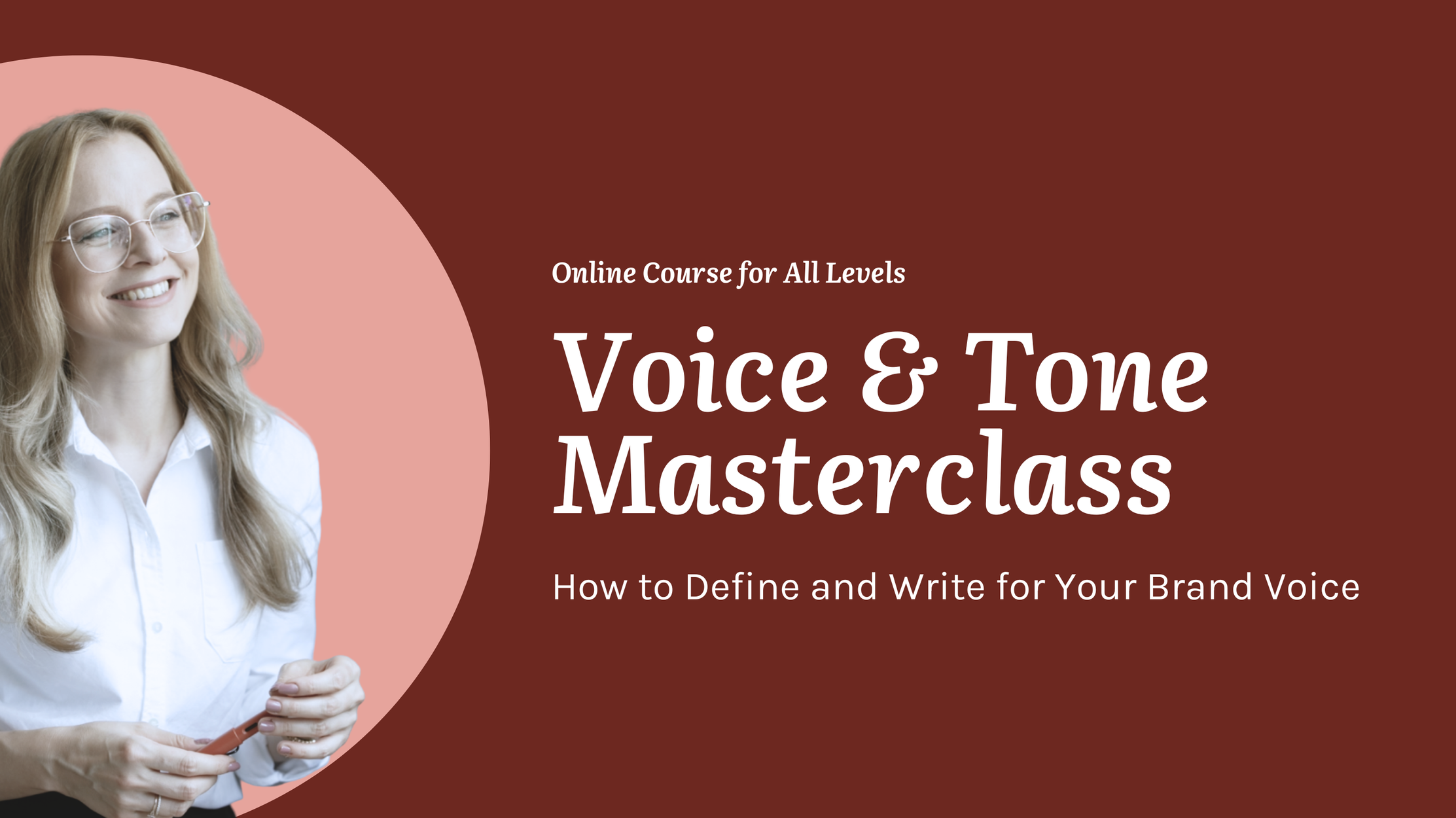
The Voice & Tone Masterclass
Level: All
Voice and tone are the foundation of consistent product and brand communication — across every writing discipline. This masterclass covers how to define a brand voice, craft actionable tone guidelines, and build style guides that teams actually use.
What you’ll learn:
Brand voice design, voice and tone principles, using voice and tone in UX Writing, creating a voice and tone style guide, managing stakeholders